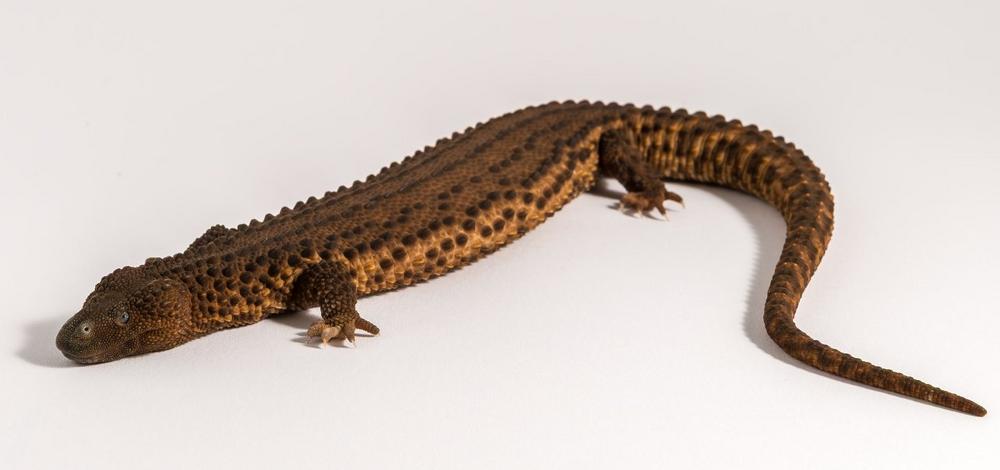
The earless monitor lizard (Lanthanotus borneensis) lives exclusively in the rainforests of Borneo. The endemic lizard is considered a “living fossil,” as it has existed for tens of millions of years at low species diversity – only a single species is known today – and has preserved primitive characteristics. “It is these particular features that give the animals their high scientific value,” explains PD Dr. Krister Smith from the Senckenberg Research Institute and Natural History Museum in Frankfurt, and he continues, “The earless monitor lizard provides important clues as to how complex venom systems have evolved in lizards and snakes.”
Together with genomicists Prof. Dr. Axel Janke and Dr. Magnus Wolf from the Senckenberg Biodiversity and Climate Research Center and Goethe University Frankfurt, Smith set out to track down this faunistic rarity. For the study, the team decoded the genome of Lanthanotus borneensis for the first time. “The reconstruction of the lizard’s genome, with its 1.5 billion base pairs, is almost complete at 93 percent – an exceptionally high value for a reptile that has hardly been studied to date,” explains Janke. “Compared to mammals and birds, there is only a small number of reptile genomes complete enough to understand their evolution in greater detail.”
Earless monitor lizards are classified as endangered and have been poorly studied to date. Their range on the Southeast Asian island of Borneo is very restricted and continues to shrink due to land use. Scientific expeditions in search of the animals are often unsuccessful. “Genetic findings on the population history are therefore also crucial in order to develop targeted conservation measures for this special species,” emphasizes Wolf.
The new study is one of the most comprehensive of its kind to date. It is based on the analysis of 966 so-called “orthologous” genes, i.e., genes that can be traced back to a common gene of origin in different species. Representatives of almost all major lineages of scaled reptiles (Squamata) were examined, including geckos, true lizards, snakes, iguanas, and anguids. Smith comments, “Our study confirms that all of the major lineages of Squamata diverged very quickly, one after another – all within the first ten percent of their entire evolutionary history. This rapid split probably led to genetic variants only separating incompletely – an effect that makes it difficult to reconstruct the phylogeny today.”
The island-dwelling lizard played a key role for the three researchers in testing the so-called “Toxicofera hypothesis.” The concept of “venomous animals” suggests that iguanas, monitor lizards, and snakes are most closely related among the scaled reptiles, that their venom glands have a common evolutionary origin, and that certain protein toxins had already evolved in the common ancestor of this group. “We were able to prove that Lanthanotus borneensis belongs to the large group of Toxicofera,” says Wolf, summarizing the analysis, and he continues, “However, our results do not provide clear evidence that certain proteins known as ‘typical’ snake venom proteins can definitely be traced back to the common origin of the Toxicofera.” Instead, another hereditary trait characteristic of reptiles showed clear traces of adaptation: the gene for the muscle protein titin, which is responsible for the elasticity of the muscles. Especially in snakes, this genetic change could be linked to their ability to open their mouths extremely wide to swallow prey, according to the research team.
“In addition, we were able to show that the genetic diversity of the earless monitor lizard is low overall and that the population size has remained relatively small for tens of thousands of years. This suggests that while this isolated species has been remarkably resilient to environmental change in the past, it may have limited adaptive capacity in the long term,” adds Smith in conclusion.
Senckenberg – Leibniz Institution for Biodiversity and Earth System Research // Senckenberg Gesellschaft für Naturforschung
Senckenberganlage 25
60325 Frankfurt
Telefon: +49 (69) 7542-0
Telefax: +49 (69) 746238
http://www.senckenberg.de
Senckenberg Forschungsinstitut und Naturmuseum Frankfurt
Telefon: +49 (69) 7542-1218
E-Mail: krister.smith@senckenberg.de
Leitung Pressestelle & Social Media
Telefon: 06975421434
E-Mail: judith.joerdens@senckenberg.de
