At a time when infotainment systems are becom ing increasingly important in vehicles — often jokingly referred to as “smartphones on wheels” — the testing of these systems is becoming more critical as well. Voice output and voice control, in particular, can provide valuable support for increasingly complex vehi cle functions, making driving easier and safer for the driver. This is because modern infotainment systems integrate car radios, navigation systems, hands-free sys tems, driver assistance systems and other functions. In addition to audio signals, digital information is con stantly exchanged with the vehicle, often via mod ern cellular communication standards.
In Search of “Pure Sound”
An important aspect is the audio quality itself, but also how it integrates into the vehicle’s environment. After all, real-world driving conditions typically don’t match the controlled conditions of a living room or concert hall. However, important information must always reach the user clearly and reliably. Even when it comes to purely entertainment-based functions like music or audiobooks/podcasts, listeners’ expectations are higher today than they were in the days of crackling and stat ic-filled FM radios. Vehicle manufacturers and their suppliers therefore require test equipment capable of objectively and reproducibly verifying and calibrating the quality of audio transmission. Such testers must be able to capture, analyze and display analog and digital audio signals with the highest possible integrity. This gives rise to various requirements. Among other things, high-quality, precise audio A/D converters are essential. The number of channels can also be critical for captur ing as many signals as possible at once. In addition to frequency and various signal level measurements, to tal harmonic distortion (THD) and FFT spectrum measurements are often required for analyzing audio signals. An integrated signal generator can also be useful in practice, as it allows for the generation of various signal waveforms and modulation types as test signals.
The MCD AudioAnalyzer Toolmonitor
A proven audio analyzer for this application is the Audi oAnalyzer from MCD Elektronik in Birkenfeld, which is available directly from MCD Elektronik or through distribution partners such as Meilhaus Electronic. It is available in various models depending on requirements. At the heart of all variants is the “AudioAnalyzer” soft ware, which centrally bundles all monitoring and analy sis functions. This control software operates as a stan dalone application for controlling the hardware variants. It offers the ability to remotely control or query all func tions and measured values from other programs. This remote control can be implemented using various soft ware interfaces such as .Net SDK, Socket, WebAPI, or Command Line. The AudioAnalyzer Toolmonitor features an intuitive graphical user interface and in cludes functions such as an oscilloscope, FFT spectrum, and measurements of AC, DC, RMS value, THD, FREQ, SINAD, and more. Captured signals, their frequency/ phase response, and other results can be visualized di rectly within the software. The generation of test signals and modulations (AM, FM, PM) is also supported.
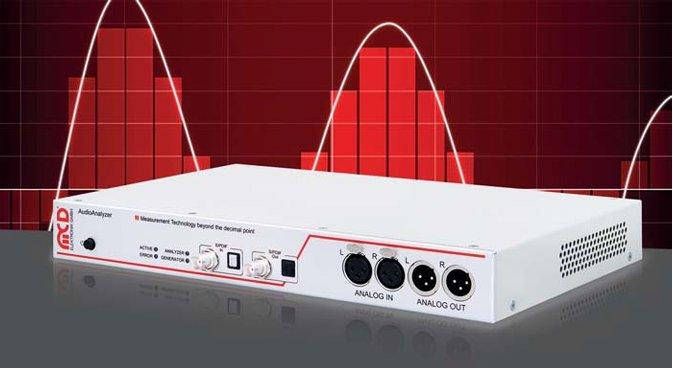
AudioAnalyzer Hardware In terms of hardware, the MCD AudioAnalyzer is avail able in four configurations designed to meet a variety of audio analysis needs. The Compact USB Edition is a compact, USB 2.0- compatible variant for direct connec tion to a PC and is ideal for space-saving worksta tions and quick measurements.
The Rack Edition is designed for installation in standard 19-inch systems and can be conveniently con trolled via USB from a host PC. The Standalone Pro Edi tion operates completely independently with an inte grated PC and enables measurements without external control. The SmartModuleS Edition is a flexible module for the MCD SmartModuleS system. In this configura tion, up to two balanced stereo inputs and outputs can be configured and additional modules can be integrated into larger enclosures such as an 84 HP SmartModuleS enclosure. All variants are available as standard from MCD Elektronik and offer maximum flexibility for pro fessional audio analysis in research, development and production. All models feature an analog, balanced ste reo input (1 mV–50 V rms, two XLR jacks) and an analog, balanced stereo output (1 mV–15 V rms, two XLR connectors). In addition, there is a digital/optical S/PDIF input and output with sample rates of up to 192 kHz (two TOSLINKcompatible connectors) and a digital coaxial S/PDIF input and output (depending on the model, two RCA jacks or two BNC connectors). The sample rates are 44.1 kHz, 48 kHz, 96 kHz, or 192 kHz with 24-bit resolution. The models differ in form factor and whether they include an integrated PC; the core features themselves are identical. In addition to clas sic audio measurement of signals from sound systems such as amplifiers, radios, TVs and infotainment sys tems, the AudioAnalyzer also enables noise measure ments on a wide variety of components such as switches, gearboxes, mechanical devices, signal genera tors, switching power supplies, distance sensors or RF modulators, extending to the calibration of tuners, transmission testing of various types of converters of various designs or noise analysis of speed measure ments.
While audio analysis in infotainment systems is clearly indispensable, particularly for voice, music and multimedia functions, its applications extend far be yond these areas. For example, the MCD AudioAnalyzer can be used for structure-borne noise measurements, such as analyzing engine and transmission noises from electrically driven components like automotive mirrors, windshield wipers, valves or central locking systems.
Through this analysis, users can identify and evaluate issues related to gear ratios, runout, concentricity, or unwanted noise generation. Such noises can be per ceived by the driver as both annoying and safety-related – such as the clicking sound of a turn signal – and are therefore examined very closely by manufacturers.
Modular with the MCD SmartModuleS
The MCD SmartModuleS is a 19-inch module system that condenses an entire test bench into a compact for mat. The device was specifically designed for small batch testing, incoming inspections or test station devel opment. Thanks to its standalone design (the base unit contains a fully integrated industrial PC) and compact size, it is also suitable for use as a laboratory or test station device. The currently available module types include a 2-channel oscilloscope featuring the technolo gy of the proven PicoScopes, an industrial, switcha ble USB hub, a digital control module and the audio analyzer described above. The advantages of the MCD AudioAnalyzer in the SmartModuleS variant lie in the fact that a system with two analyzers can be configured with minimal effort, enabling a total of four mono or two stereoinputs and outputs. This allows even extensive measurement setups to be implemented costeffective ly while maintaining the flexibility and precision of au dio analysis. This system is available as a preconfigured solution. However, an 8-channel PicoScope or “mixed” configurations can also be implemented in a SmartModuleS system housing.
Summary
Audio analysis is a key factor in vehicle infotainment systems, but also in many other fields when it comes to testing and analyzing sound events. The MCD Audio Analyzer offers interesting and proven solutions in this area, both in terms of hardware and software. The mod ular design of the MCD SmartModuleS allows for the cost-effective configuration of an audio analyzer with multiple channels. (bs)
MCD Elektronik GmbH
Hoheneichstr. 52
75217 Birkenfeld
Telefon: +49 (7231) 78405-0
Telefax: +49 (7231) 78405-10
http://www.mcd-elektronik.de
Marketing Coordinator
Telefon: +49 (7231) 78405-78
Fax: +49 (7231) 78405-10
E-Mail: Anja.Erler-Szegedi@mcd-elektronik.de
