Highlights from Powerline North:
AX-26-874 – 13.03 g/t Au over 14.2 metres (“m”), (true width 90% – 12.8m)
o including 18.10 g/t Au over 1.5m,
o 142.7 g/t Au over 1.0m,
o and 12.77 g/t Au over 1.2m; and,
o 0.80 g/t Au over 54.5 m including 6.39 g/t Au over 1.5m.
AX-26-832 – 1.17 g/t Au over 11.2m within 0.57 g/t Au over 26.1m
o including high-grade of 7.40 g/t Au over 1.0m
AX-26-840 – 1.86 g/t Au over 13.9m,
o including high-grade of 22.30 g/t Au over 1.0m; and,
o 0.42 g/t Au over 59.0m, including high-grade of 13.90 g/t Au over 0.5m
AX-26-871 – 1.42 g/t Au over 13.5m
o including high-grade of 16.03 g/t Au over 0.6m, 4.07 g/t Au over 0.4m and 9.81 g/t Au over 0.3m
“The 13.03 g/t Au over 14.2 metres intersected in AX-26-874 is an exceptional result, while its location is equally important,” stated Tara Christie, President & CEO. “This intercept extends high-grade mineralization into the largely undrilled gap between Powerline and Airstrip, an area currently classified as unmineralized in the resource model. Our 2026 program is designed not only to convert resources, but also to identify these higher-grade domains and demonstrate the potential to increase both contained ounces and the overall grade profile at AurMac.”
The high-grade interval in AX-26-874 is characterized by a high density of extensional quartz veins with bismuth sulphosalts, arsenopyrite and pyrite, together with multiple occurrences of visible gold. The 142.70 g/t Au over 1.0 m interval is associated with a locally brecciated extensional quartz vein containing coarse-grained to semi-massive arsenopyrite (Figure 5).
Analytical Method and Quality Assurance/Quality Control Measures
The reported work was completed using industry standard procedures, including a quality assurance/quality control (“QA/QC”) program consisting of the insertion of certified reference materials, field duplicates and coarse blanks into the sample stream and utilizing certified independent analytical laboratories for all assays. Additionally, historic QA/QC data and methodology on the AurMac Project were reviewed and are summarized in the Technical Report. The Qualified Person detected no significant QA/QC issues during review of the data.
A robust system of standards, core duplicates and coarse blanks was implemented in all Banyan drilling programs and was monitored as chemical assay data became available. All control samples were within accuracy and precision thresholds required to meet data quality standards. These control samples amounted to approximately 10% of all samples submitted to analytical laboratories.
All diamond drill core was systematically logged and photographed by Banyan geology personnel. All core samples (HTW and NTW diameter) were split on-site at Banyan’s core processing facilities. Once split, half samples were placed back in the core boxes with the other half of split samples sealed in poly bags with one part of a three-part sample tag inserted within. Samples were delivered by Banyan personnel or a dedicated expediter to the Bureau Veritas, Whitehorse preparatory laboratory where samples are prepared and then shipped to Bureau Veritas’s Analytical laboratory in Vancouver, B.C. for pulverization and final chemical analysis.
Core splits reported in this news release were analysed by Bureau Veritas of Vancouver, B.C., utilizing the four-acid digestion ICP-ES 35-element MA-300 or ICP-ES/MS 59-element MA-250 analytical package with FA-450 50-gram Fire Assay with AAS finish for gold on all samples. Samples returning >10 g/t Au were reanalysed by fire assay with gravimetric finish on a 50g sample (FA-550). High-grade samples with documented visible gold are also analysed using metallic screen fire assay (FS-652). Samples returning >200 g/t Ag (MA250 or MA300) were analysed by multi-acid digestion ICP-ES MA370. If samples returned > 1,500 g/t Ag, they were analysed by fire assay with gravimetric finish on a 50g sample (FA550). If samples returned > 10,000 g/t Ag, they were analysed by fire assay 2g sample (FA501). Bureau Veritas is an accredited laboratory following ISO/IEC 17025:2017 SCC File Number 15895. A robust system of standards, ¼ core duplicates and blanks has been implemented in the 2026 exploration drilling program and is monitored as chemical assay data becomes available.
Qualified Persons
Duncan Mackay, M.Sc., P.Geo., is a “Qualified Person” as defined under National Instrument 43-101, Standards of Disclosure for Mineral Projects (“NI 43-101”), and has reviewed and approved the content of this news release in respect of all disclosure other than the MRE. Mr. Mackay is Vice President Exploration for Banyan and has verified the data disclosed in this news release, including the sampling, analytical and test data underlying the information.
Upcoming Events
• GCFF Conference, Vancouver, September 19, 2026
• Precious Metals Summit, Beaver Creek, September 22-25, 2026 o Corporate Presentation: September 23 at 1:30 PM MDT
• Denver Gold Forum, Colorado Springs, September 27-30, 2026
• The MoneyShow, Orlando, October 5-7, 2026
About Banyan
Banyan’s primary asset, the AurMac Project is located in the Traditional Territory of the First Nation of Na-Cho Nyäk Dun, in Canada’s Yukon Territory. The AurMac Project comprises two main deposits, the Airstrip and Powerline Deposits. Mineralization is characteristic of a Reduced Intrusion Related Gold system, hosted in auriferous cross-cutting sheeted quartz veins and replacement style mineralization hosted in skarn horizons. The current Mineral Resource Estimate (“MRE”) for the AurMac Project has an effective date of May 15, 2026 and comprises an Indicated Mineral Resource of 3.639 million ounces of gold (“Au“) (167.3 M tonnes at 0.68 g/t) and an Inferred Mineral Resource of 4.985 Moz of Au (267.2 M tonnes at 0.58 g/t) (See MRE Table below; as defined in the 2014 CIM Definition Standards for Mineral Resources and Mineral Reserves incorporated by reference into NI 43-101). The 303 square kilometres (“sq km”) AurMac Project lies 40 kilometres from Mayo, Yukon. The AurMac Project is transected by the main Yukon highway and benefits from a 69 kV 3-phase powerline, existing power substation and cell phone coverage.
CAUTIONARY STATEMENT: Neither the TSX Venture Exchange, its Regulation Services Provider (as that term is defined in policies of the TSX Venture Exchange) nor OTCQB Venture Market accepts responsibility for the adequacy or accuracy of this release.
No stock exchange, securities commission or other regulatory authority has approved or disapproved the information contained herein.
FORWARD LOOKING INFORMATION: This release contains forward-looking information, which is not comprised of historical facts and is based upon the Company’s current internal expectations, estimates, projections, assumptions and beliefs. Such information can generally be identified by the use of forward-looking wording such as “may”, “will”, “expect”, “estimate”, “anticipate”, “intend(s)”, “believe”, “potential” and “continue” or the negative thereof or similar variations. Forward-looking information involves risks, uncertainties and other factors that could cause actual events, results, performance, prospects and opportunities to differ materially from those expressed or implied by such forward-looking information. Forward looking information in this news release includes, but is not limited to, the potential for resource expansion and increased grades; mineral recoveries and anticipated mining costs. Factors that could cause actual results to differ materially from such forward-looking information include uncertainties inherent in resource estimates, continuity and extent of mineralization, capital and operating costs varying significantly from estimates, the preliminary nature of metallurgical test results, delays in obtaining or failures to obtain required governmental, environmental or other project approvals, political risks, uncertainties relating to the availability and costs of financing needed in the future, changes in equity markets, inflation, changes in exchange rates, fluctuations in commodity prices, and the other risks involved in the mineral exploration and development industry, enhanced risks inherent to conducting business in any jurisdiction, and those risks set out in Banyan’s public documents filed on SEDAR+. Although Banyan believes that the assumptions and factors used in preparing the forward-looking information in this news release are reasonable, undue reliance should not be placed on such information, which only applies as of the date of this news release, and no assurance can be given that such events will occur in the disclosed time frames or at all. Banyan disclaims any intention or obligation to update or revise any forward-looking information, whether as a result of new information, future events or otherwise, other than as required by law.
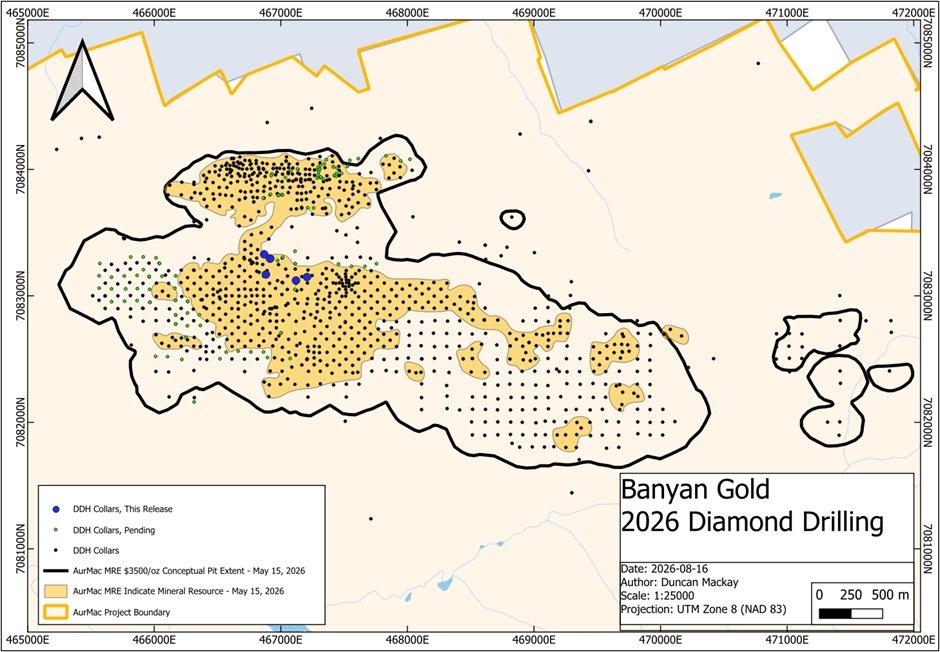
Figure 1: Plan map of AurMac, Yukon, Canada. Drillholes in this release highlighted in blue (Figure 2). Pending results in green. All other diamond drilling is in black. The gaps between Airstrip and Powerline fall within the conceptual pit boundary but remain largely undrilled except for the two fences of drilling in the centre and eastern end of the area.
Figure 2: Plan map of Powerline North. Drillholes in this release highlight the potential to extend and delineate new high-grade zones in the core of Powerline (Figures 3 and 4). Drillholes AX-26-832, -840, -845, and -850 drill off angle to test continuity of mineralization below the substation infrastructure.
Figure 3: Cross-section 467100mE from Powerline North at AurMac. Mineralized domains are overlaid on the lithologic model. Mineralization remains open up-dip toward the largely undrilled gap between the Airstrip and Powerline Deposits and at depth. The high-grade interval in AX-26-874 (Figure 5) highlights the potential to extend mineralized domains beyond the current resource model and to identify additional mineralization within areas currently estimated at low grade or as unmineralized within the conceptual pit shell. The MRE block model is constrained by mineralized and lithologic domains. Mineral Resource blocks are 10m x 10m x 5m. Only blocks above the 0.30 g/t Au cut-off and within the US$3,500/oz Au conceptual pit shell are included in the MRE. Lithologic domains at Powerline are dominated by metasedimentary rocks of various compositions, typically mica chlorite schists with varying calcareous content. Domains shown in this section are: CLSR_4 and 5 – chlorite-sericite schist; CSCH_1 and 3 – calcareous schist; and sch_2 – heterogeneous schist.
Figure 4: Cross-section 466900mE from Powerline North at AurMac. Mineralized domains are overlaid on the lithologic model. Mineralized domains are open up-dip and at depth, with potential to expand the mineralized envelope at depth. The MRE block model is constrained by mineralized domains and the lithologic domains. Mineral Resource blocks are 10m x 10m x 5m. Only blocks above the 0.30 g/t Au cutoff and within the US$3,500/oz Au conceptual pit shell are included in the MRE.
Figure 5: Mineralized extensional quartz veins in metasedimentary rocks in Powerline North from diamond drillhole AX-26-874. High density of extensional quartz veins with bismuth-sulphosalts, arsenopyrite, and pyrite found throughout the mineralized interval from 160.0-174.2m, which graded 13.03 g/t Au over 14.2m and hosts several instances of visible gold mineralization (Figure 6). Locally, very high-grade gold intersection of 142.70 g/t Au over 1.0m is associated with locally brecciated quartz extensional vein with coarse-grained to semi-massive arsenopyrite.
Swiss Resource Capital AG
Poststrasse 1
CH9100 Herisau
Telefon: +41764802584
Telefax: +41 (71) 560-4271
http://www.resource-capital.ch
Swiss Resource Capital AG
Telefon: +41 (71) 354-8501
E-Mail: mo@resource-capital.ch
