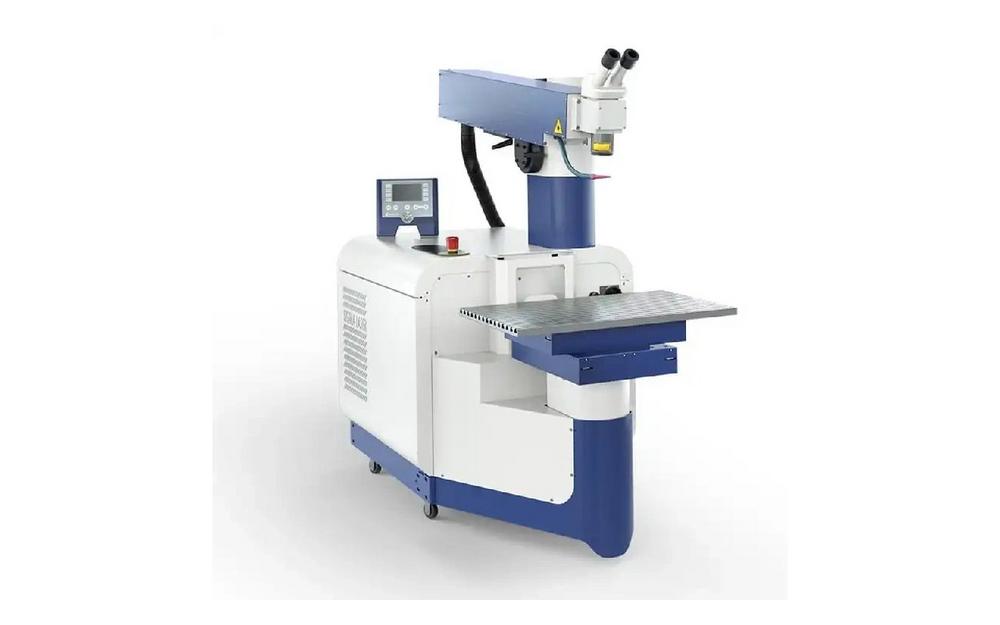
A toolmaker faces a worn parting-line edge on a hardened H13 insert. The repair must restore the edge with a build-up that stays hard, without softening the surrounding steel or distorting the tool. In these cases, the lamp-pumped Nd:YAG system delivers the required energy density in a single pulse. The guide to Nd:YAG laser welding machines explains how this source fits demanding tool repair, and where the fibre laser becomes the better option.
Pulse energy sets the penetration and keeps the steel hard
A lamp-pumped Nd:YAG laser operates at 1064 nm in pulsed mode, reaching pulse energies up to 170 J, peak power up to 13 kW, and pulse durations from 0.5 to 20 ms. In pulsed welding, the pulse energy—not the average power—sets how deep the weld penetrates in each shot. This allows the operator to set a deep seam in a single pulse, for example on tool steels like 1.2344 or 1.2343. The surrounding steel remains hard, and the tool keeps its original dimensions.
Typical jobs for the pulsed Nd:YAG laser in tool repair
The pulsed Nd:YAG system is suited to repairs where high energy in a short pulse is needed. Typical applications include:
- Edge build-up and restoration of worn radii on moulds and dies in tool steel 1.2344 or 1.2343
- Repairing damaged sealing edges without softening the tool
- Local build-up with filler wire for precise geometry restoration
- Working on hardened inserts where dimensional accuracy is critical
- Jobs requiring access to undercuts and curved edges, using a Leica 10× stereo microscope and five-axis kinematic (X·Y·Z·C·D)
Mobile systems can be brought directly to the tool in the press, while stationary systems stand in the toolroom.
The fibre laser takes over for long seams, thin sections and high pulse rates
Where the job calls for long continuous seams, thin sections, or high pulse rates in series production, the fibre laser becomes the preferred source. The fibre laser operates at 1070 nm and can run in both pulsed and continuous wave modes. Unlike the lamp-pumped system, it has no lamp to change, which affects maintenance routines. In the Nd:YAG system, the flash lamp is a wear part and must be replaced as part of regular maintenance.
"On tool steels, I have seen the pulsed Nd:YAG laser set a deep, precise seam in one shot, with the surrounding area staying hard and undistorted. For long seams or very thin parts, the fibre laser gives more control over heat input and can run without interruption," says Alexander Bellouzi, Senior Design & Engineering at Sigma Laser.
A sample weld on the customer’s own tool steel settles the choice between sources before purchase. The guide to fibre laser welding machines explains the applications in detail. Sigma Laser assesses seam quality, penetration and the heat-affected zone, so the toolmaker can decide based on the actual result.
Sigma Laser has developed and manufactured industrial laser welding systems in Hanau, Germany, since 2005. The range comprises six five-axis systems – mobile (Sineo Light, Sineo Fibre, Sirius Light) and stationary (Sidanus Light, Sidanus Fibre, Siega Fibre) – with Nd:YAG (1064 nm) or fibre laser sources (1070 nm), complemented by Simass automation modules and Super Pulse Technology. The Sineo system won the German Design Award 2025; customers are located in more than 25 countries.
Sigma Laser GmbH
Pfaffenbrunnen Str. 158
63456 Hanau-Steinheim
Telefon: +49 (0)6181 413 6679
https://sigma-laser.com
