Key components of SmartDose
SmartDose encompasses multiple features that work in tandem to reduce dose. Combined, these features provide a seamless workflow experience that prioritizes image quality, patient safety and dose efficiency.
LASER POSITIONING DEVICE
Allows for precise patient alignment without unnecessary exposure.
OBJECT DETECTED DOSE CONTROL (ODDC)
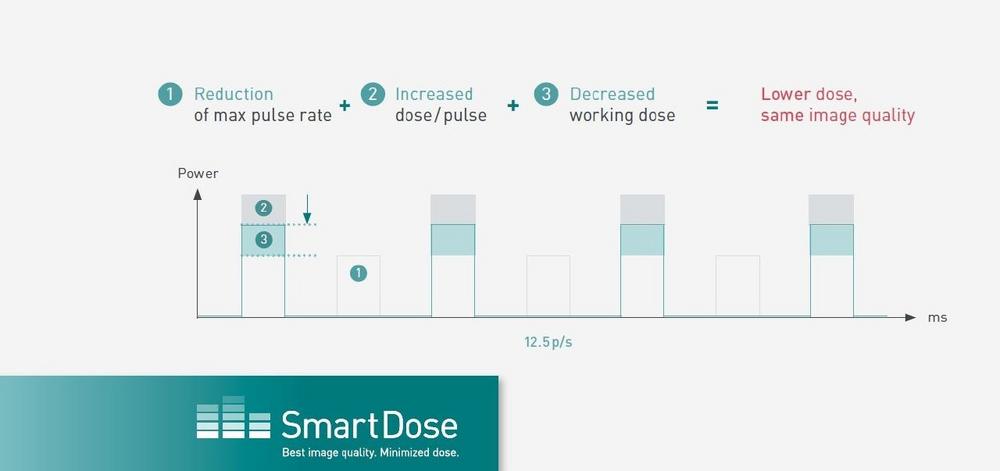
Detects patient anatomy in real time and dynamically adjusts exposure parameters and noise reduction filters, while also featuring an automatic pulse rate reduction during static imaging for optimal dose and image quality.
HIGH-SPEED AUTOMATIC DOSE REGULATION (ADR)
High speed X-ray exposure control for optimal exposure parameters, including tube voltage and tube current, ensuring excellent image quality at minimized dose levels.
ZAIP (ZIEHM ADAPTIVE IMAGE PROCESSING)
Advanced image processing algorithms and noise reduction filters that enhance contrast between soft tissue, bone, and metal to visualize even finest structures like guidewires.
VIRTUAL COLLIMATORS
For exposure-free positioning of slot and iris collimators.
BEAM FILTRATION
BeamFiltration2 is an advanced anti-scatter grid paired with an optimized beam hardening which selectively removes low-energy X-ray photons, thereby significantly reducing patient dose and improving image quality.
REMOVABLE ANTI-SCATTER GRID
Enhances image contrast by suppressing scattered radiation. For pediatric or low-dose applications, the grid can be removed to reduce entrance skin dose.
PREMAG
Digital pre-magnification of the live monitor image when switching to a different magnification mode, allowing the user to preview the field of view of the next image taken without additional exposure.
Additional considerations
In addition to advanced X-ray beam filtration, SmartDose leverages pulsed fluoroscopy to further minimize dose levels. Unlike continuous fluoroscopy, which delivers a constant beam, pulsed operation emits short, high-frequency bursts of X-rays. Ziehm Imaging’s monoblock generators produce well-defined pulses with minimal overlap and heat generation, enabling a significant dose reduction compared to continuous modes (Figure 1).
To optimize both image quality and dose efficiency, the system dynamically adjusts pulse rates: higher frequencies (e.g. 25 pps) are used during motion to avoid blur, while lower rates (e.g. 8 pps) are applied when anatomy is at rest. High-speed ADR ensures seamless transitions, while adaptive noise reduction filters are applied in real time to maintain image clarity at reduced dose levels.
Conclusion
Ziehm Imaging’s SmartDose represents a paradigm shift in dose management for mobile C-arms. This technology not only upholds ALARA principles but also enhances clinical reliability and image quality. SmartDose empowers healthcare professionals to achieve superior outcomes with minimal health risk to patients, setting a new standard in interventional imaging.
More information: The Right Dose – Ziehm Imaging
References
1. Kazuta Yamashita, Kosaku Higashino, Hiroaki Hayashi, Fumio Hayashi, Yoshihiro Fukui, Koichi Sairyo: Pulsation and Collimation During Fluoroscopy to Decrease Radiation: A Cadaver Study. In: JBJS Open Access; 2017
2. European Society of Radiology (ESR): White paper on radiation protection by the European Society of Radiology. In: Insights Imaging; 2011
3. Ron Villane, Kimberly Haas, Anne-Kathrin Meier, Günther Stelzer: Dose Management at Ziehm Imaging; 2016
1 The SmartDose concept includes a variety of hard- and software features. Due to regulatory reasons the availability of each feature may vary. Please contact your local Ziehm
Imaging sales representative for detailed information.
2 The technology Beam Filtration reduces dose exposure for Ziehm Imaging flat-detector systems in comparison with conventional filtration techniques. Data on File. Results may vary.
Ziehm Imaging, founded in Nuremberg in 1972, is a leading medical technology company specializing in the development, manufacturing and worldwide marketing of mobile X-ray-based imaging solutions. With a diverse portfolio ranging from mini C-arms from its daughter company Orthoscan to motorized full-size C-arms from Ziehm Imaging, the company covers the broadest spectrum of clinical applications and services. Together with its second daughter company Therenva, Ziehm Imaging sets standards with innovative solutions in the cardiovascular and endovascular fields that enable efficient planning and navigation. With more than 50 years of experience in research and innovation, Ziehm Imaging stands for setting standards in intraoperative imaging with state-of-the-art technology and excellent image quality. Thanks to the mobility of the C-arms, clinics benefit from flexible application options, lower installation costs and a lower radiation dose. Ziehm Imaging employs more than 900 experts at its global headquarters in Nuremberg and its numerous international offices in the USA, China and many other countries.
About Therenva
Therenva has been a daughter company of Ziehm Imaging since 2020. With the innovative solutions EndoSize and EndoNaut, Ziehm Imaging sets standards in the cardiovascular and endovascular fields. Thanks to powerful AI-based algorithms, precise measurements and intraoperative image fusion, the toolset enables efficient planning and safe navigation during minimally invasive procedures.
About Orthoscan
Orthoscan, founded in 2002 and now also a daughter company of Ziehm Imaging, is committed to the development and design of mini C-arms – particularly in the field of innovative imaging solutions for the extremities, orthopedics and trauma surgery. Orthoscan’s TAU family of mini C-arms are designed and approved for pediatric use. Equipped with new intelligent technologies, the TAU systems enable significant dose savings without compromising image quality.
Ziehm Imaging GmbH
Lina-Ammon-Straße 10
90471 Nürnberg
Telefon: +4991166067 0
Telefax: +4991166067390
http://www.ziehm.com
Marketing Manager Communication & Clinical
Telefon: +49 911 66067 0
E-Mail: marketing@Ziehm.com
