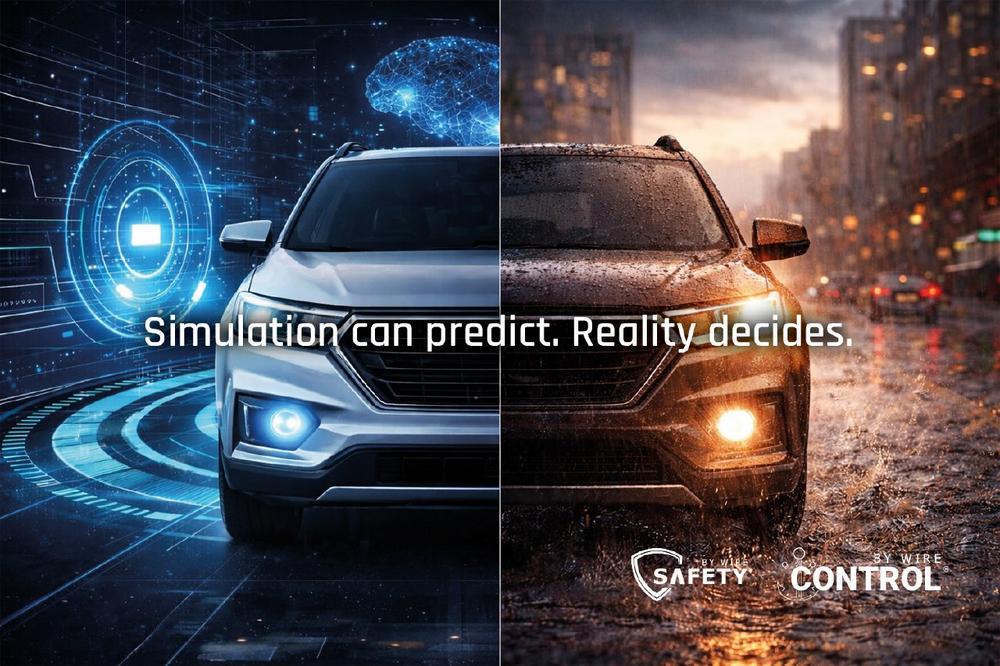
The decisive challenges of autonomous systems lie not in how vehicles perceive their environment, but in how they must act. Not in simulation, but in real-world operation. Not in ideal conditions, but in dealing with deviations, errors, and physical limits. It is precisely in this tension that the true maturity of drive-by-wire systems emerges.
Drive-by-wire matures in operation, not in the lab
Many autonomy programs are developed in controlled environments. This is necessary for perception, planning, and decision-making logic. For vehicle control, however, it is of limited value.
Drive-by-wire proves its resilience where systems must function reliably over long periods of time. Where electronic control is not experimental, but part of ongoing operations. Where a failure does not lead to the termination of a test, but poses a real risk.
A significant portion of this experience comes from applications in which electronic vehicle control has had to operate for years without a mechanical fallback—such as in mobility solutions for people with physical disabilities. In such systems, there is no manual fallback. For example, the user cannot intervene if their electronic controls fail. Redundancy, error detection, and continued operation must therefore be fully ensured by the system itself.
This requirement corresponds precisely to the situation of autonomous vehicles: While humans serve as a fallback in assistance systems, this role is completely eliminated as the degree of automation increases (see SAE J3016). Vehicle control must therefore be designed from the outset as a fail-operational system. Arnold NextG’s drive-by-wire expertise has also been developed over decades in such real-world operational contexts.
The origins of this system logic
The roots of modern drive-by-wire systems do not lie primarily in autonomous driving. They extend back to safety-critical domains, particularly aviation. There, mechanical control linkages were replaced early on by electronic systems to design complex systems to be controllable, redundant, and fault-tolerant.
This approach was later applied to select automotive applications—not as a convenience feature, but as a prerequisite for reliable vehicle control under real-world conditions. This gave rise to an architectural understanding that remains valid today: systemic redundancy, deterministic control, and physical feedback are not extensions of existing systems, but fundamental prerequisites for vehicle control to be possible at all without a human fallback.
Real-world operation reveals whether these principles hold up. Systems must function reliably over many years, under changing conditions, with clearly defined requirements for safety, availability, and predictability. Fault conditions are not exceptions here, but part of normal operation.
It is precisely here that it becomes clear what vehicle control must actually achieve. Safety is not achieved through shutdown, but through controlled system behavior. Redundancy is only effective when it is utilized across the entire system. And models alone are not sufficient to fully represent physical reality.
Normative frameworks such as ISO 26262 for functional safety define the basis for such systems, but do not replace the experience gained from real-world operation.
Reality beats the model
Many challenges facing autonomous systems arise from the discrepancy between model and reality. Coefficients of friction change, forces do not act linearly, and systems behave differently than expected under load. Drive-by-wire experience from real-world applications means being able to handle precisely these deviations.
This experience is cumulative. It is built up over generations of products and has a lasting impact on architectural decisions. Autonomous systems today face precisely this challenge: they must not only calculate decisions but also reliably implement them under real-world physical conditions.
Maturity Comes from Responsibility
Against this backdrop, the age of a company loses its significance. What matters is not when an organization was founded, but under what conditions its systems have been operated. Drive-by-wire maturity does not arise from speed, but from responsibility in real-world deployment.
Technological leadership is not demonstrated through visions or roadmaps, but through the ability to reliably map and master physical reality. Platform approaches such as NX NextMotion from Arnold NextG draw on this experience and translate it into scalable, fail-operational vehicle architectures for autonomous applications.
Autonomous driving is thus not a break with existing principles, but their consistent further development. Systems thinking, redundancy, feedback, and responsibility form the foundation for vehicles to function reliably without a driver. Drive-by-wire is not the future of vehicle control—but its present, when developed from real-world experience.
We control what moves!
In the concluding article of this series, we examine what it means when artificial intelligence actually becomes part of the physical world—and what requirements this places on the next generation of vehicle control.
More information: www.arnoldnextg.com/blog
Arnold NextG realizes the safety-by-wire® technology of tomorrow: The multi-redundant central control unit NX NextMotion enables a fail-safe and individual implementation, independent of the vehicle platform and unique worldwide. The system can be used to safely implement autonomous vehicle concepts in accordance with the latest hardware, software and safety standards, as well as remote control, teleoperation or platooning solutions. As an independent pre-developer, incubator and system supplier, Arnold NextG takes care of planning and implementation – from vision to road approval. With the road approval of NX NextMotion, we are setting the global drive-by-wire standard. www.arnoldnextg.com
Arnold NextG GmbH
Breite 3
72539 Pfronstetten-Aichelau
Telefon: +49 171 5340377
http://www.arnoldnextg.de
Business and Corporate Development
E-Mail: mathias.koch@arnoldnextg.de
