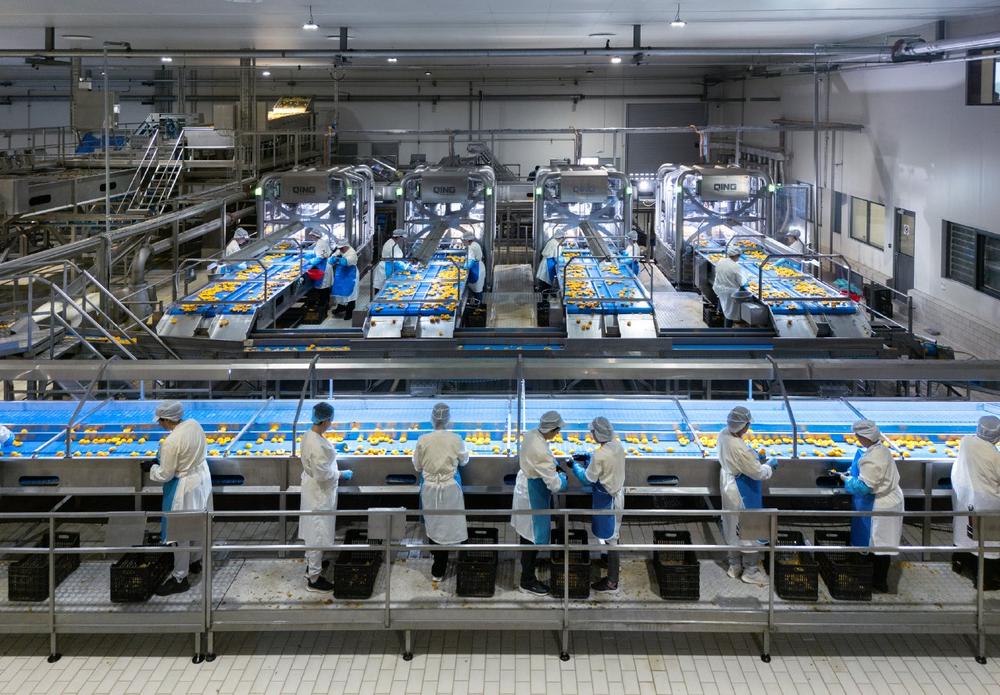
Agrophoenix was founded in 2018 in Greece’s Imathia region as “not just another fruit processing company” with the aim of “creating something new and fresh,” says Lazaros Ioannidis, Partner and Project Manager. “We had the vision to create a company that differentiates itself from business models and standards not only in Greece but in our sector overall.”
This suggests that Agrophoenix uses packaging and processing formats beyond the typical canning. According to Lazaros Ionnaidis, “We have, for example, established a new production line for fruit balls in pouches, and we are able to pack aseptic diced fruit in 200-liter bins that we can use all year round for products in cups.”
Another innovation was implemented for grading peaches, with the primary goal of removing those with pit fragments. After the fruit is washed, steam-peeled, cut into halves and depitted, it is pre-inspected by a vision system, mainly for color. The peach halves then arrive at one of eight conveyors, each leading to a very compact cell containing an AI-assisted vision system and a food-grade Stäubli HE robot.
High-quality peach grading in next to no time
In the cell, the camera captures every single peach half and inspects it in milliseconds. Immediately after screening, the robot picks the N.I.O. halves and places them on belts running to the right and left of the main conveyor, while the majority exit the cell for further processing.
Two things are especially worth noting here. First, QING, a Dutch startup that developed the STAQ system, uses AI to train the vision system. This means the user, in this case Agrophoenix, can easily determine and teach it the difference between acceptable and defective products, and adjust the parameters as needed.
Inspecting 15 tons of peaches an hour, one at a time
Even more impressive is the speed and performance of the robot cells. “The robots can pick one peach half per second,” says Will Uijting, Commercial Director of QING. And since the N.I.O. rate is low because the fruits have already been graded, 15 tons of peaches can pass through the eight STAQ cells each hour.
The conversion of tons to peaches is not quite precise, since each fruit is different. As Lazaros Ioannidis explains, “We calculate in weight, not pieces. A peach weighs approximately 150 g, so 15 tons means 100,000 peaches per hour and 200,000 halves, more or less. And 3,600 of them can be rejected in that time.”
What happens with the rejected peaches? “At the moment, we only look for pits and pick them out in two channels: those with small pits and those with bigger ones,” says Will Uijting. “Those with bigger pits are directed to automated re-pitting, and the smaller ones go to manual inspection. Then both are fed back into the STAQ stations.”
An obvious choice: The robot
In the STAQ cells, a Stäubli TS2-80 SCARA robot selects the N.I.O. peaches. Precision and durability played a role in choosing the robot, as did connectivity to the control system. A main criterion was, of course, hygienic compliance. Will Uijting: “It is a TS2-80 in the HE version, which means that it has washdown capabilities: The joints of the robot are well protected, all materials are corrosion-resistant, and an inner pressure prevents vapor, steam or water from entering the housing during cleaning.“ Further, QING opted for a filling of H1 oil – a logical choice because the robots are top-mounted over the conveyors carrying the peach halves.
The cells need frequent cleaning. Lazaros Ioannidis: “During the days of operation, every four hours the lines stop for 20 minutes and an automatic CIP-like cleaning starts. Each Sunday, a more intense cleaning with a food-grade detergent takes place.“ This is exactly what the Stäubli robots in the EHEDG-compliant HE version are designed for – frequent cleaning without compromising the longevity that Stäubli robots are known for.
The biggest challenge: Designing the gripper
As for why it took two and not one season to get the eight QING cells production-ready, the answer is clear: It’s neither the AI, the software, nor the robots, but the gripper or, to be more precise, the material that comes into contact with the peaches. Will Uijting: “The peeled peaches are slippery, so we had to find a conveyor material on which the peaches hold their position. Even more difficult was the effective picking, grabbing, and releasing of the peaches with their cups upside down.” The engineers had to find the right vacuum gripper with the right contact material.
The next challenge: Robot-based removal of pit fragments
In the end, they found the right combination, and the AI-based peach grading, with Stäubli HE robots picking the rejected peaches, successfully completed its first harvest season at the Agrophoenix plant. The collaboration with QING will continue in engineering, as Lazaros Ioannidis explains: “The next step is a difficult one, but we will try. Together with QING, we want to develop an automated system that is able to remove pit fragments from the peach halves – before or after the sorting. That’s our next big thing.”
STAQ by QING: More than robot-based inspection
The cell with a camera and robot is only the visible part of the system that QING in Arnhem, Netherlands, has engineered. The complete solution is an automation framework called STAQ, developed specifically for the food industry. The acronym stands for See, Think, Act. Will Uitrijt, Commercial Director: “We look at the product with sensors or cameras, we determine what to do with it, and we act upon it. This works for different and difficult products, not only fruit like peaches, but also meat and biscuits. The software and the functions are always the same, while the grippers and the algorithms are adapted to the products and sorting parameters.” The cells are equipped with Stäubli HE (humid environment) SCARA robots to meet hygienic requirements in the food industry.
About Stäubli
Stäubli is a global industrial and mechatronic solution provider with four dedicated Divisions: Electrical Connectors, Fluid Connectors, Robotics and Textile, serving customers who aim to increase their productivity in many industrial sectors. Stäubli currently operates in 28 countries, with agents in 50 countries on four continents. Its global workforce of 6,000 shares a commitment to partnering with customers in nearly every industry to provide comprehensive solutions with long-term support. Originally founded in 1892 as a small workshop in Horgen/Zurich, Switzerland, today Stäubli is an international Group headquartered in Pfäffikon, Switzerland.
https://www.staubli.com/global/en/home.html
About Stäubli Robotics
Stäubli Robotics is a leading global player in robotics, consistently delivering engineering as effective and reliable as our services. A complete solutions provider for digitally networked production, Stäubli offers a broad range of 4- and 6-axis robots including robotic arms designed specifically for sensitive environments, mobile robots, driver-less transport systems (AGVs) and cobots for human-robot collaboration.
[url=https://www.staubli.com/global/en/robotics/products.html]Robotic automation for industrial applications | Stäubli[/url]
https://www.linkedin.com/company/staubli-robotics/
Stäubli Tec-Systems GmbH Robotics
Theodor-Schmidt-Str. 19/25
95448 Bayreuth
Telefon: +49 (921) 883-0
Telefax: +49 (921) 883-3244
https://www.staubli.com/de/de/robotics.html
Manager of Marketing and Division Business-Marcom
Telefon: +49 (921) 883-3212
E-Mail: s.koban@staubli.com
North East Europe – Regional Marketing & Communication Robotics
Telefon: +49 (921) 883-3219
E-Mail: n.backer@staubli.com
