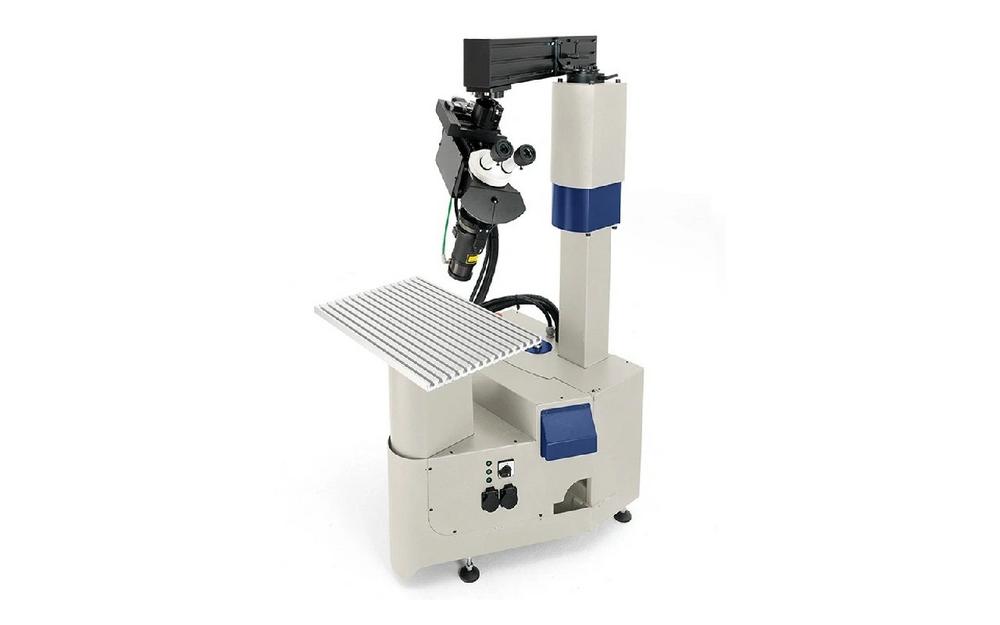
In many workshops, a part previously repaired one at a time is now planned for series welding from the next quarter. The question arises: does this require a new system, or can the existing workstation be adapted? The transition from manual repair to series production follows three clear stages. The article on industrial laser welding systems for series production explains how a single workstation can grow into a fully automated welding cell.
Teach-in and stored programmes even out results between operators and shifts
The first stage is the single workstation. The operator creates the initial weld programme using teach-in on the Sigomatic control. The weld path is defined with a joystick and geometry primitives, followed by a dry run and a test weld. Once the result meets requirements, the programme is stored. Up to 50 programmes can be saved in memory, expandable to over 100. Stored programmes ensure every seam is welded the same way, regardless of operator or shift. This consistency is valuable when moving from individual repairs to small batch production.
CNC kinematics, open frame, and fibre laser enable reproducible series welding
The second stage introduces 5-axis CNC kinematics (X·Y·Z·C·D), allowing the system to repeat every seam under programme control. Set-up is supported by a Leica 10× stereo microscope. The open frame design accommodates parts of any size and weight, with part heights up to 450 mm, regardless of table size. For longer seams and shorter cycle times, the fibre laser in continuous wave mode is used. Super Pulse Technology keeps the heat-affected zone small.
Which stage is appropriate depends on the production requirement:
- Repair and small batches: single workstation with teach-in.
- Recurring parts with stable seams: stored programmes and CNC kinematics.
- High volume and short cycles: automation with rotary table or slide.
Automation with rotary table or slide increases throughput
The third stage is automation. The Simass base unit can be equipped with interchangeable modules. The Simass Rotate module is a precision rotary table with two separate zones, allowing parallel loading and unloading while welding continues; the table measures up to 1,500 mm in diameter. The Simass Slide module uses motor-driven pivoting slides for long or large workpieces, with loading and unloading outside the enclosure. Both modules allow the cell to keep running without interruption.
"I have seen that when series production ramps up, the biggest improvements come from reducing manual handling and waiting times. Adding the right module makes the welding process more predictable and stable, especially for recurring series parts," says Klaus Schickert, Production Manager at Sigma Laser.
A sample weld on the customer’s series part is carried out before purchase. The next stage is set out on the page of the Simass base unit with interchangeable modules
Sigma Laser has developed and manufactured industrial laser welding systems in Hanau, Germany, since 2005. The range comprises six five-axis systems – mobile (Sineo Light, Sineo Fibre, Sirius Light) and stationary (Sidanus Light, Sidanus Fibre, Siega Fibre) – with Nd:YAG (1064 nm) or fibre laser sources (1070 nm), complemented by Simass automation modules and Super Pulse Technology. The Sineo system won the German Design Award 2025; customers are located in more than 25 countries.
Sigma Laser GmbH
Pfaffenbrunnen Str. 158
63456 Hanau-Steinheim
Telefon: +49 (0)6181 413 6679
https://sigma-laser.com
