Skip to content

PR-Web

Press releases worldwide

  • Home
  • Contact
  • Datenschutzerklärung
  • Legal notice

Author: Firma Arnold NextG

When Digital Commands Meet Real-World Vehicle Physics

Posted on 8. October 2026 by Firma Arnold NextG Posted in General Tagged Autonomous Vehicles, control gap, controlled motion, defense platforms, drive-by-wire, mission systems, motion validation, NX NextMotion, System-Integration, teleoperation, unmanned vehicles, vehicle architecture, Vehicle Control, vehicle dynamics, Vehicle Motion Assurance

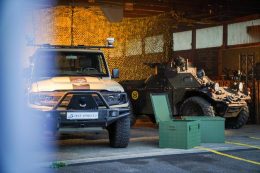
Autonomous and unmanned defense platforms must be able to execute movement requirements in a controlled manner even when conditions change during a mission. Terrain, traction, gradient, load, or vehicle condition all influence whether a digitally planned movement is actually feasible. […]
Read More

Teleoperation with Drive-by-Wire: Why Remote Control Requires a Closed-Loop Vehicle Control System

Posted on 29. September 2026 by Firma Arnold NextG Posted in General Tagged Autonomous Vehicles, Defence Mobility, Defence Teleoperation, Digital vehicle control, drive-by-wire, fail operational, Force Feedback, NX NextMotion, Remote Operations, Safety-Oriented Control, Steer-by-Wire, System-Integration, teleoperation, vehicle architecture, Vehicle Control Loop

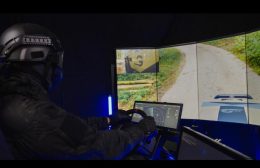
Teleoperation relocates the operator’s station outside the vehicle. Technically, however, this involves much more than just a change in the location from which a person issues commands to steer, brake, or accelerate. In a conventionally operated platform, the driver receives […]

Read More

Defense Retrofit with Drive-by-Wire: How Existing Platforms Are Being Modernized for Digital Vehicle Control

Posted on 15. September 2026 by Firma Arnold NextG Posted in General Tagged autonomous driving functions, Defence retrofit, digital controllability, Digital vehicle control, drive-by-wire, fleet modernisation, military vehicle modernisation, NX NextMotion, platform-specific integration, safety-related control, System-Integration, teleoperation, vehicle architecture, vehicle modernisation, vehicle retrofit

Military vehicles are designed for long service lives. Many platforms remain in service for decades and are modernized several times during that period. At the same time, their missions—and thus the requirements for vehicle architecture—are changing: teleoperation, autonomous driving functions, […]

Read More

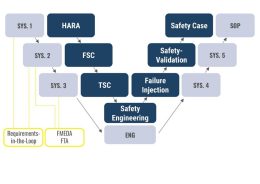
Functional Safety for Drive-by-Wire: How a Comprehensive Safety Case Demonstrates Safety from Requirements Through to Operation

Posted on 1. September 2026 by Firma Arnold NextG Posted in General Tagged drive-by-wire, fault injection, FMEDA, FTA, Functional Safety, Hardware in the loop, Lifecycle Management, NX NextMotion, Requirements-in-the-Loop, Safety Argumentation, safety case, traceability, Vehicle-in-the-Loop, Verification Chain

A safety-critical drive-by-wire system may be technically sound in its design. For OEMs, Tier 1 suppliers, and system integrators, however, that alone is not enough. Functional safety must be verifiably demonstrated—both to auditors and regulatory agencies as well as within […]

Read More

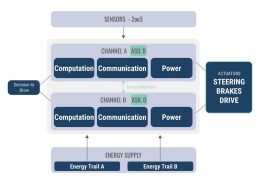
Fully Fail-Operational Drive-by-Wire: When the Safe State Means Continuing to Drive

Posted on 25. August 2026 by Firma Arnold NextG Posted in General Tagged arbitration, ASIL D, Communication Paths, Control Layer, Degradation Concept, drive-by-wire, fault tolerance, Fully Fail-Operational, Motion Control, NX NextMotion, power supply, redundancy, Safety-by-Wire, sensor systems, System Architecture

In traditional vehicle systems, a safety strategy may involve shutting down a malfunctioning function and returning control to the driver. But what happens when there is no longer a driver available as a fallback? For autonomous and teleoperated vehicles, this […]

Read More

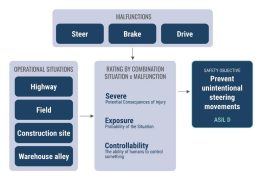
Functional Safety for Drive-by-Wire: When the Most Stringent Requirement Sets the Standard

Posted on 18. August 2026 by Firma Arnold NextG Posted in General Tagged ASIL D, Control Layer, drive-by-wire, Functional Safety, HARA, hazard analysis, ISO 26262, NX NextMotion, risk assessment, risk metrics, safety architecture, safety case, Safety Objectives, Safety-by-Wire, Standards Consolidation

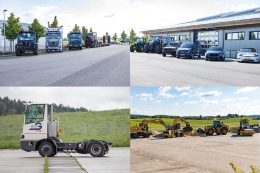
An autonomous shuttle in city traffic, a tractor in a field, or a wheel loader on a construction site operate in different risk environments. Accordingly, different standards apply to functional safety. But what happens when a drive-by-wire platform is to […]

Read More

Functional Safety for Drive-by-Wire: Why a Standard Alone Is Not Enough

Posted on 13. August 2026 by Firma Arnold NextG Posted in General Tagged ASIL D, autonomous systems, Control Layer, drive-by-wire, Functional Safety, hazard analysis, ISO 26262, multi-domain platform, redundant architecture, Regulatory Compliance, risk metrics, safety case, SOTIF, technical requirements, verification strategy

Autonomous and remotely controlled vehicles place new demands on vehicle architecture. Where steering, braking, and propulsion are electronically controlled, control over vehicle movement must be ensured at all times—even in the event of a fault. This makes drive-by-wire a safety-critical […]

Read More

Drive-by-Wire and Control Layer: Why Controlled Vehicle Movement Is Becoming a Key Technology for Autonomous Vehicles

Posted on 4. August 2026 by Firma Arnold NextG Posted in General Tagged actuators, AD stack, automated driving systems, Brake Systems, Control Layer, drive-by-wire, fail operational, Functional Safety, NX NextMotion, safety architecture, Software-defined Vehicles, Steering Systems, System-Integration, teleoperation, vehicle architecture

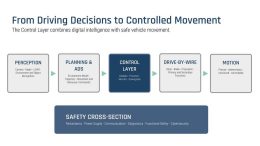
The new UN regulations R185 and GTR No. 26 establish an international framework for automated driving systems. At the same time, the UNECE ADS Working Group is developing Guidance and Interpretation Documents (GID) intended to support the practical application of […]

Read More

New Global ADS Regulations: Why the Control Layer Is Becoming a Key Technology for Software-Defined Vehicles

Posted on 28. July 2026 by Firma Arnold NextG Posted in General Tagged automated driving systems, Control Layer, drive-by-wire, fault tolerance, Functional Safety, Homologation, Minimal-Risk Maneuver, NX NextMotion, Software-defined Vehicles, teleoperation, Type Approval, UN GTR No. 26, UN R185, vehicle architecture

With the adoption of UN Regulation No. 185 and UN Global Technical Regulation No. 26 for Automated Driving Systems, UNECE WP.29 established a new international reference point— —in June 2026. It applies to highly and fully automated driving functions within […]

Read More

New Global ADS Standards: Arnold NextG Puts the Control Layer at the Center of Future Vehicle Architectures

Posted on 22. July 2026 by Firma Arnold NextG Posted in General Tagged Control Layer, drive-by-wire, fail operational, Functional Safety, Homologation, NX NextMotion, teleoperation, UN GTR No. 26, UN R185, UNECE, vehicle architecture

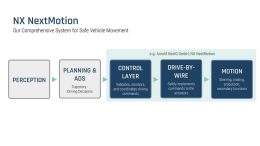
Key Takeaways: The new ADS regulations are technology-neutral but address safety across development, approval, and operation. This makes the safe implementation of digital driving decisions a distinct architectural and validation topic. Arnold NextG describes Safety-by-Wire® and NX NextMotion as platform-independent […]

Read More

Posts navigation

Older posts

Copyright 2016. All rights reserved.


Back To Top
We use cookies to ensure that we give you the best experience on our website. If you continue to use this site we will assume that you are happy with it.